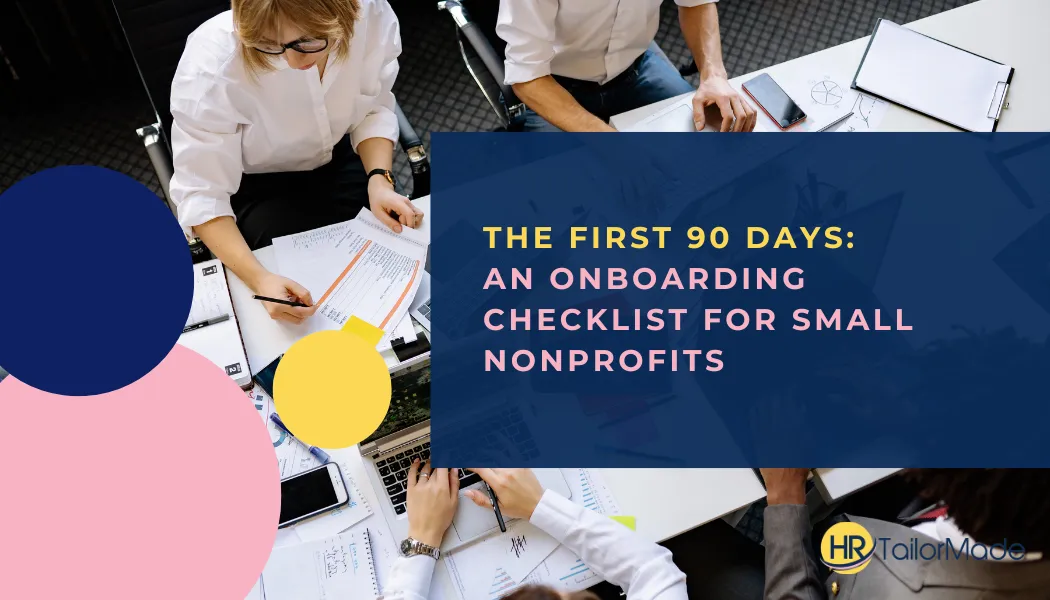
The First 90 Days: An Onboarding Checklist for Small Nonprofits
April is National Volunteer Month—a time to celebrate the people who give their time, energy, and heart to mission-driven work.
But here is a question worth sitting with: How well are we onboarding the people we ask to carry that mission forward?
Not just volunteers. Employees, too.
Because the data is clear. 20% of new hires leave within the first 45 days. Among organizations without a structured onboarding process, that number climbs. And for small nonprofits—where every role carries outsized impact—each early departure is a crisis, not just a statistic.
The cost? Somewhere between 40% and 200% of that person's annual salary, depending on the role. For an organization running on grant funding and donor goodwill, that math is devastating.
And yet, most nonprofit onboarding still looks like this: a stack of paperwork, a quick office tour, a login to the shared drive, and a wish for good luck.
That is not onboarding. That is administrative processing.
Real onboarding is a (minimum) 90-day investment in someone's success. Here is what it looks like when it works.
Before Day One: The Preboarding Phase
Onboarding does not start on the first day. It starts the moment someone accepts the offer.
Organizations that skip preboarding are significantly more likely to lose new hires in their first six months. The fix is simple:
→ Send a welcome message from the team—not just HR, not just the ED. The actual people they will work alongside.
→ Share key documents early: the employee handbook, organizational chart, mission statement. Let them absorb this on their own terms. Don’t forget to send their new hire forms and benefits election documents, too. Allow them time to complete essential forms at their own pace.
→ Set up their workspace, email, and tools before they walk in. According to recent research, 43% of employees say it took over a week just to get basic workstation logistics in place. That delay sends a message about how prepared—or unprepared—the organization is.
→ Assign a "buddy" or go-to person who is not their supervisor. Buddy programs dramatically improve both cultural connection and early productivity.
Week One: Orientation with Intention
Week one should answer the question every new hire is quietly asking: Did I make the right choice?
→ Start with mission, not manuals. Share why the organization exists, who it serves, and what success looks like in human terms. Save the policy review for later.
→ Introduce the team—but with context. Instead of just names and titles, share what each person does and how the new hire's work connects to theirs.
→ Walk through role expectations clearly. Research shows that 39% of new hires had to figure out their responsibilities on their own. That should never happen in a small team where clarity is achievable.
→ Make the handbook accessible, not just available. One client we work with turned their handbook rollout into a team-based treasure hunt—turning a normally tedious task into something people actually looked forward to. The staff loved it, and retention of the information was noticeably higher.
Days 8–30: Building Rhythm
This is where most onboarding programs end. It should not be.
→ Schedule weekly check-ins with the direct supervisor. Not performance reviews—conversations. "What is going well? What feels unclear? What do you need?"
→ Begin role-specific training with a clear 30-day milestone. What should this person be able to do independently by day 30?
→ Introduce the new hire to external stakeholders: board members, key community partners, program participants. Context builds commitment.
→ Revisit the mission. Now that they have some experience, ask: "How does your work connect to our mission?" This is not a test. It is a grounding exercise.
Days 31–60: Deepening Connection
→ Expand responsibilities gradually and intentionally. Confidence comes from competence, not from being thrown into the deep end.
→ Facilitate a feedback conversation—both directions. Ask the new hire what the organization could do better. Their fresh perspective is valuable.
→ Connect them to professional development. Even small investments—a webinar, a book, a conference session—signal that the organization is invested in their growth, not just their output.
Days 61–90: From New Hire to Team Member
→ Conduct a 90-day touchbase meeting. Not a performance evaluation—a mutual check-in. Is the role what they expected? Are they getting the support they need? What should shift?
→ Celebrate the milestone. Recognition does not have to be expensive. A team acknowledgment, a handwritten note from the ED, a mention at a staff meeting. What matters is that someone notices.
→ Transition from onboarding to ongoing development. Create a six-month learning plan together.
Research from BambooHR found that 91% of employees who received an effective introduction to company culture felt connected to their workplace. For those with poor onboarding? Just 29%.
The Volunteer Connection
This month is a good time to ask another question: Does the organization apply the same intentionality to volunteer onboarding?
Volunteers are often the backbone of small nonprofits. They interact with clients, represent the organization in the community, and carry the mission into spaces staff cannot reach. If their onboarding is a one-page orientation sheet and a lanyard, the organization is leaving impact—and retention—on the table.
The principles are the same. Mission first. Clarity of expectations. A human connection. A reason to stay.
The Bottom Line
Strong onboarding does not require a big budget. It requires intention.
A structured 90-day process can improve new hire retention by 82% and increase productivity by over 70%.
For a small nonprofit, that is not just an HR best practice. That is mission protection.
What does onboarding look like at your organization? Drop your biggest challenge—or your best practice—in the comments.
#NonprofitOnboarding #EmployeeRetention #NewHireProcess #SmallNonprofit #HRForNonprofits #NonprofitLeadership #OnboardingChecklist #NationalVolunteerMonth
At HR TailorMade, we help small nonprofits build onboarding processes that set every new hire up for success—from preboarding through the first 90 days and beyond. Book a free strategy session.