What It Actually Looks Like When a Nonprofit Gets HR Right
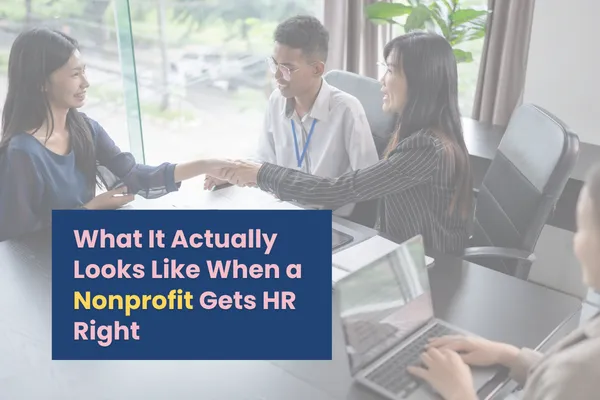
What It Actually Looks Like When a Nonprofit Gets HR Right
Practical HR for Nonprofits | May 2026 | 8 min read
Many nonprofit Executive Directors know something is missing on the people-side of their organization.
They just don't know what it is or what "done" looks like.
That is not a failure of leadership. It is a predictable outcome of building a mission-driven organization without a dedicated HR professional. Many EDs learn HR the way they learn everything else: by doing it, getting it wrong, and hoping the gap doesn't surface at the worst possible moment.
This article is for the ED who is ready to stop guessing. Here is what a well-run nonprofit people operation actually looks like — across five domains that matter most for organizations with 1 to 50 staff.
Why Some Nonprofits Skip This Work
The honest answer is this: HR feels like overhead.
When you are running a 15-person organization and every dollar is accountable to a program outcome, investing in people infrastructure feels self-indulgent. There are grants to write, programs to deliver, and a board expecting results.
But here is what that math misses.
"Replacing a single employee costs between 50% and 200% of their annual salary — not counting the mission disruption that follows."
For a nonprofit where one person's departure can stall a program, that is not an HR problem. That is a financial and strategic problem wearing clothing.
The organizations that take people operations seriously are not the ones with the biggest budgets. They are the ones that have decided their people are worth protecting.
The Five Domains of a Well-Run People Operation
A strong people operation is not one big thing. It is five interconnected domains, each one building on the last.
Domain 1: Employment Foundations
This is the legal and structural layer. It includes offer letters, employment classifications, I-9 verification, labor postings, and the documentation practices that protect your organization and your staff.
Most nonprofits have some of this — but not all of it, and rarely in one place. The gaps are invisible until they are not.
DONE = Every active employee has a complete, current file. Offer letters match actual job responsibilities. Employment classifications — exempt versus non-exempt — are correct and documented. Labor law postings are in a central location. I-9 records are accurate and completed correctly.
Domain 2: Policies and Practices
This is the staff handbook and everything around it. Not just the document — but whether the policies in it are current, whether staff know about them, and whether leaders actually follow them.
A staff handbook that has not been updated in three years is not a policy. It is a liability.
DONE = Your handbook reflects your current operating reality, including remote work provisions, leave policies, and any state-specific requirements that apply to your team and organization. It has been reviewed in the past 12 months and, attorney approved. And when a staff member asks a question about policy, someone can answer it.
Domain 3: Hiring and Onboarding
How you bring people in shapes everything that follows. A hiring process that is inconsistent or rushed produces inconsistent results. Onboarding that is focused on paperwork instead of the mission and belonging produces staff who feel like contractors.
DONE = You have a defined hiring process. Not a different one every time. Job descriptions are accurate. Interview questions are consistent and legally compliant. New hires have a structured first 90 days that introduces them to the mission, work, and the team, not just the handbook.
Domain 4: Performance and Development
This is the domain many nonprofits skip entirely and the one most likely to surface in an exit interview.
Staff want to know how they are doing. They want to grow. When there is no formal feedback process, they fill the silence with their own interpretation and it is rarely generous.
DONE = Performance conversations happen on a regular cadence, not just when something goes wrong. Staff have clear expectations and know how success is measured. Development conversations happen at least annually. And performance issues are documented and addressed, not ignored until separation.
Domain 5: Culture and Retention
Culture is not a value on a website. It is the sum of every daily experience your staff have at work. And retention is not a perk, it is the outcome of culture done well.
DONE = You know why people stay, because you ask. You conduct stay conversations not just exit interviews. You have a sense of how your staff experience the culture, and you use that information to make decisions.
Where to Start
If reading this list feels like a diagnosis, that is useful information. Most organizations are not failing in all five domains. They are strong in two and genuinely unprepared win the others.
The most common pattern is strong on hiring energy, weak on documentation and performance. Organizations hire with care and then lose people because the infrastructure to keep them never got built.
The first step is an honest look at where you are. Not aspirationally, but actually.
Three questions worth asking this week:
When was the last time someone reviewed your staff handbook?
If a key staff member left tomorrow, how prepared would you be to document why and replace them well?
Do your staff know how they are doing, not from informal feedback but from a real conversation?
The answers will tell you where to start.
The Bottom Line
A well-run people operation is not a luxury for organizations with full-time HR staff. It is a baseline that any nonprofit, regardless of size, can build.
It does not require an HR director. It requires systems, documentation, and the decision to take your people operations as seriously as you take your programs.
Because your programs are delivered by your people. The foundation under them matters.
What is the one people domain at your organization that you would least want a funder to ask about? Share in the comments.
#NonprofitHR #NonprofitLeadership #PeopleOperations #HRTailorMade #NonprofitManagement #SmallNonprofit #MissionDriven
Building a people (HR) operation that protects your mission takes intention — and it does not have to be complicated. At HR TailorMade, we assess, build, and maintain people operations for small nonprofits so you can lead without the people-side weighing you down. Take the 3-minute HR Health Check at hrtailormade.com/quiz-nonprofit to see where your organization stands.