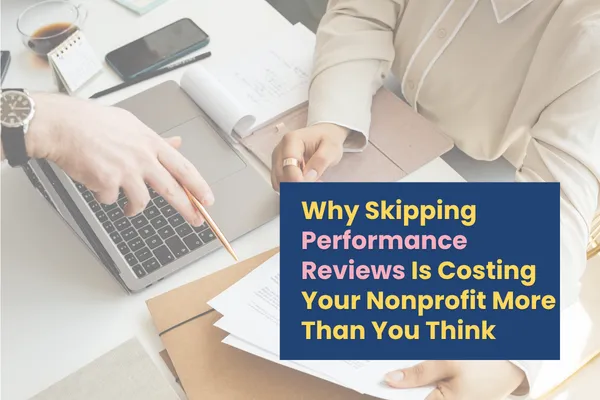
Why Skipping Performance Reviews Is Costing Your Nonprofit More Than You Think
Practical HR for Nonprofits | June 2026 | 7 min read
Leaders know they should be doing performance reviews.
Most of them are not doing them, or doing them so infrequently and informally that they are not producing any of the outcomes a real review process is designed to deliver.
This is not a character flaw. It is a capacity problem. When you are running a 15-person organization and wearing seven different hats, a formal review process feels like something for organizations with HR departments, not for you.
But the research and the real-world cost data actually shows skipping performance reviews is not saving you time. It is creating a set of downstream costs that are significantly more expensive than the reviews themselves.
This article is about what those costs are and what a review process that actually works looks like for a small nonprofit.
What You Lose When Reviews Don’t Happen
Clarity — for your staff
When staff do not receive regular, structured feedback, they operate without a clear picture of where they stand. They make assumptions about their performance and those assumptions are rarely accurate in both directions.
High performers who are not told they are valued begin to wonder if they are. Average performers who are not told where to improve continue operating below their potential. Both outcomes cost the organization.
A review process does not have to be elaborate to provide clarity. It has to be consistent.
Retention — of your best people
The correlation between meaningful performance feedback and employee retention is well-documented. According to Gallup, employees who receive regular feedback are significantly more engaged and engaged employees are substantially less likely to leave.
For a nonprofit where one departure can disrupt a program, retention is not an HR metric. It is a mission metric.
The organizations that retain their best staff are not always the ones that pay the most. They are the ones where staff feel seen, developed, and invested in. Performance reviews, done well, are one of the primary mechanisms for creating that experience.
Documentation — when you need it most
When a performance issue escalates to the point where termination is necessary, the question that will determine your legal and financial exposure is simple: what documentation do you have?
Organizations that skip reviews typically have limited documentation. That means that when a termination is challenged, and some will be, there is no or a limited paper trail demonstrating that the employee was informed of performance expectations, given feedback, and given the opportunity to improve.
The cost of a wrongful termination claim, even one that is ultimately resolved in your favor, can easily exceed $50,000. The cost of a consistent review process is a fraction of that.
A development pipeline — for future leadership
Small nonprofits that grow are the ones that develop their people intentionally. A review process is not just about evaluating current performance, it is about identifying who has the capacity to take on more, who needs support to get there, and who is in the wrong role entirely.
Without regular reviews, those conversations never happen. Talent goes underdeveloped. Gaps in leadership capacity only become visible when they need to be filled urgently.
What a Review Process Looks Like at a Small Nonprofit
One of the barriers for most small nonprofits is not the will to do reviews, it is not knowing what a review process looks like at their size. Here is a practical framework:
Frequency | Twice a year, minimum. Once in November and once in May aligns naturally with fiscal year rhythms.
Format | A structured conversation, not a form. The form can come later. The conversation is what matters.
Content | Three questions (for both the supervisor and employee) minimum: What is going well? What needs to improve? What support do you need from me?
Documentation | A brief written summary after the conversation, emailed to the employee, and saved to the employee’s file. One paragraph is sufficient.
Follow-through | One specific commitment from each party before the next check-in.
This is not a performance management system. It is a starting point. For a small nonprofit without an HR function, it is also sufficient to produce the clarity, retention, and documentation outcomes described above.
The Conversation Most Leaders Avoid
The single most skipped review conversation is the one about underperformance.
Most leaders know when a staff member is not performing at the level the role requires (and so does the team). Most of them avoid saying so directly because the conversation is uncomfortable, because they are worried about the person’s reaction, or because they do not know how to frame it constructively.
But avoiding the conversation does not make the performance issue go away. It makes it worse. And it signals to the rest of the team that underperformance is tolerated, which is one of the fastest ways to erode a culture.
‘The performance conversation you avoid in June becomes the resignation or the termination in October. Either way, you have the conversation. The difference is whether you have it on your terms or theirs.’
Constructive performance feedback does not require perfect language. It requires honesty, specificity, and the genuine intention to help the person improve. Oftentimes, when given clear feedback and real support, staff members respond positively. Those who do not have given you important information.
If You Haven’t Done Reviews This Year
June is an excellent time to start, not because fiscal year-end creates a legal requirement, but because the natural pause in program activity creates a practical window.
If you are starting from scratch, do not try to implement a comprehensive performance management system in the next three weeks. Do this instead: schedule 30-minute conversations with each staff member. Ask the three questions above. Write a brief summary. Put it in their file.
That is a performance review. It is not perfect. It is significantly better than nothing and it creates a foundation to build on.
If the idea of building a real performance process feels overwhelming on top of everything else you are managing — that is exactly the situation The Blueprint is designed for. A 60-minute session, a written assessment, and a clear starting point. Book at https://hrtailormade.com/the-blueprint.
Has your organization done performance reviews in the past six months? What gets in the way? Share in the comments.
#NonprofitHR #NonprofitLeadership #HRTailorMade #PerformanceManagement #Retention #SmallNonprofit #MissionDriven